Thursday, February 23, 2012

Time Travel in RPGs

I've always been a fan of time travel stories. I believe my first experience in being pulled in to such a story was a Twilight Zone episode, in which a group of friends are gathered in 1961, discussing time travel. One of the friends, Peter Corrigan, soon finds himself back in 1865, the day Lincoln was assassinated. He attempts to prevent the assassination, but fails.

My next memorable encounter with such a story was Ray Bradbury's "The Sound of Thunder", which involved a leisure company that offered safaris to the past. One could travel back in time and kill a dinosaur. But there were strict rules so that the time stream would not be altered in any significant way. These rules are of course, broken.

Both stories showcase two very different approaches to time travel. In one approach, all events along the time stream are fixed. In the other, the slightest change in the past can result in wild deviations in the future.
There are all sorts of fancy terms for theories which fall into either category (Many Worlds Interpretation being among them). Fancy terms and theories aside, when I wanted to incorporate time travel into my campaign world, I had to take a stance.

I decided that for pure logistical reasons, I didn't want my players traveling into the past and re-writing the history of my world. It is hard enough to design a single campaign world. Creating endless variations of that world based on the whims of players hopping through time has always seemed to me to be far too much work. Instead, I settled on the idea that the past, as well as the future, are fixed. One can travel through time, but they can not re-write it.

What then, becomes the point of time travel adventures?

My approach to time travel in my campaigns has been convoluted, but resulted in many fun adventures. The basic premise behind time travel is that you may find that the things you know about the past or future are simply wrong, or that you yourself were an instrument in shaping things the way they are. Most events are malleable to some extent... as long as your excursion through time results in people BELIEVING the same things they've always believed, actual interpretation of how those beliefs came to be are an emergent result of game play.

For example, in the case of someone trying to stop the assassination of Lincoln, they may find that someone else actually committed the act and framed John Wilkes Booth. Or that Lincoln's death was faked, and it was a double that was killed. Or any number of possible events that have the end result in the belief that Lincoln was killed at the Ford Theater by Booth on April 14, 1865.

The thing to consider is that according to game world rules, the reality encountered by the players is the ONLY reality... it was always the only reality. They did not change the past through time travel. They merely discovered the truth of it.

I will give a concrete example of one such adventure I ran. The Lord of Time (who I refer to as Darkstar, Archon of Time in my current campaign) recruited a certain gnomish thief for a mission. It seems that the Dwarven city of Stonehaven had fallen to an evil force. Within the stronghold is a Dwarven artifact. If the evil forces get ahold of this artifact, they will not only subdue the Dwarves, but control them as a force. The gnome must enter the Dwarven city, find the artifact, and steal it.

Now.. the problem is that the city has already fallen, and Darkstar doesn't know if the evil forces have gotten their hands on the artifact yet. He does know that prior to the invasion, the artifact was safe in the vaults of the Dwarves. So... he sends the gnome back in time, just prior to the invasion. The gnome can't simply go snooping around the vaults, nor can he ask for the hammer. He must wait for the invasion and the following chaos to ensue in order to be able to freely explore. And so, he actually becomes part of the futile defense of the city. He later finds the artifact. Once he has it in his hands, his "recall" spell is triggered, and he is re-united with Darkstar.

Now... something interesting happened during this adventure. He found himself in a battle which the Dwarves were destined to lose, because it had already happened. While his actions could have an affect to some extent, there was a limit to the affect. He was in what many players would consider a "railroad".

Personally, I don't concern myself with such terms. I know how I want to use time travel, and how I don't want to use it. The success of the player's mission was not guaranteed. He found there were things he could affect, and things he couldn't. He recognized these quickly, and rather than complaining about it, switched strategy. He used his wits to convince the Dwarven king to move the artifact, and while it was in transit, he had his opportunity to steal it. All in all, it was quite a memorable adventure. One of the fun things about it was being able to put a player character in the middle of a battle, but be unconcerned with the overall result of it. He knew the battle was lost before he ever started. He still had many opportunities to shine, helping individuals who otherwise might have been "collateral damage".

Running such adventures is challenging. As in Back to the Future 2, people and artifacts can wind up being in two places as the same time. Time travelers can potentially meet themselves. One must keep an eye on the development of Djinn artifacts.

From a lecture by Princton professor Richard Gott:


Self consistent time travel stories have some interesting features. We
introduced the concept of a "Djinn" - a particle whose world line is
like a hula hoop - a circle with no ends (the name was introduced by
Igor Novikov).  An example was given with the 1980s movie "Somewhere
in Time", (in which a pocket watch that was given to the protagonist
by an old lady is brought back in time and given to the younger
version of this lady, who in turn grows old to give it to the
protagonist - thus this pocket watch, which has never been near a
watch factory, is a "djinn").
There are numerous other challenges in running time travel adventures. Particularly ones in which time is self consistent. However, they can be very rewarding, and quite memorable for all involved.

Saturday, February 18, 2012

I need suggestions!

I've come to a creative block on my Shatterworld blog. So far, I've detailed monsters, men, some geography, and the mythos of Calabria. I need to pick a direction for my next series of posts, but don't know where to go. Some options:

1) More geography
2) More history
3) Spotlight on specific cultures (rangers, paladins, mercenary warriors, clans, clerics, magic users)
4) Legends

If you have any ideas on what direction you'd like to see me go, leave a comment. Maybe something that I haven't even touched on yet?

All the support and encouragement is greatly appreciated!

Monday, February 13, 2012

Just a little experiment in drawing

Just a little thought exercise in perspective drawing. Nothing to see here. More along.


Ok... if you really want to know, it is a representation of a sine wave in 360 panoramic views.

Sunday, February 12, 2012

"Barbarian" Classes: Fighter, Thief, Druid, Bard, Witch

"Barbarian" is a pejorative term typically assigned to groups of hunter/gatherers by those who consider themselves "civilized". This post specifically describes the "clans of men" in Calabria, and how standard Labyrinth Lord and similar classes fit within the "barbarian" or "noble savage" context.

"Barbarians" have a +2 penalty to their reaction roles when dealing with "civilized" people.

The clans each have a general territory they claim as their own. These territories are most often in rugged wilderness such as forests, mountains, remote costs or even small islands. Each clan has a totem animal. Totems include but are not limited to: bear, wolf, gryphon, eagle, deer, horse, badger, squirrel, boar, viper.

Most adult members of the clans (both male and female) are fighters. Spread of levels is similar to those of "civilized" cultures, with only a small percentage reaching the highest of levels. A chieftain might be 10th level or higher, with his sons typically also being among the highest levels in the clan.

Clan members have limited ability to assume "animal shape". For three consecutive days, once per month (usually centered on the full moon) members have the ability to assume the shape of their totem once per day. The duration of the transformation can be as long as four days, but each day the member does not transform back to human, there is a cumulative 25% chance that they will forget their humanity, and remain permanently in animal form. (Remaining in animal form for four whole days automatically results in permanent transformation)

Clan members in their home territory or similar terrain gain several advantages. Due to their close ties to their animal totem, clan members are only surprised on a 1 in 6. With two turns of mental preparation they can also perform the following as a thief of half their level (round up).

Find Traps (snares, pits, etc...)
Hide (camouflage)
Hear Noise
Detect Smell (same chance as Hear Noise)

(These abilities typically don't work in environments very different from their home territory, as they are unable to discern sounds/smells/traps elements that are out of the ordinary for that environment. A clansman of a forest environment would be displaced underground or in a city. Certain strong smells, such as orc or their totem animal, might be detectable regardless of environment).

Fighters
Fighters are limited to medium or light armor (nothing more than 40 pounds of armor).

Thieves
Thieves can not pick pockets or locks, but perform other thieving abilities as a thieves 2 levels higher

Druids
Each clan has a resident Druid. However, Druids are respected equally among all clans. Druids are the arbiters of the clans, and a ruling by a Druid is respected equally among all clans. A Druid can demand the cessation of combat between two clans for up to three days, but such cessation can not be demanded again for one year by any Druid.

Bards
Bards are identical to Druids, with the following exceptions:
They must use a chosen instrument to cast their spells.
Casting spells takes two full turns
They do not have the Druid armor or weapon limitation (but do have the clan armor limitation)
They get Charisma bonus to casting spells (targets must subtract Bards charisma bonus from saving throws)

Witches
"Witches"are anomalies in their clan. They are considered "touched" by the gods, and typically live apart from the clan.

They can create "fetishes", potions, and charms. These items can be used one single time. They can be used by the Witch, or given away. They are only effective as intended if they are given freely by the witch, as in most cases they must be made specifically for the recipient and the target. If taken against the will of the witch, use of the items can have unpredictable results. These items can match the effects of any Druid, Cleric, or Magic user spell of level equal to the Witch.

Witches are zero level for fighting purposes.

Friday, February 10, 2012

Three Pillars of D&D

"Much has been made of late in the online community over a post on Wizard's of the Coast's "Rule of Three" about the "three pillars of Dungeons and Dragons". On 2/7, Rodney Thompson wrote in response to the following question:

"I frequently have games when throughout the entire session we go without any combat whatsoever. What can I expect from the new edition in regards to this style of play?"

Rodney responds in part:

"Over the course of the last year, we've distilled the essential experiences of D&D down into three general categories: exploration, roleplaying, and combat. We believe these form the three main pillars of gameplay in D&D, and, while broad, they can help guide our design...

The goal, then, is to support all three of those elements in the design of the game in such a way that the individual gaming group can choose its focus and have a satisfying game experience. This doesn't mean we necessarily need the same amount of game mechanics supporting each; obviously, combat has tended more toward detail and more rules support, and that may well be true going forward, but we also want to make sure we're paying a similar amount of attention to the other two experiences...


This philosophy is something we want to extend beyond just character design; it should affect adventure design, monster design, setting design, and every other aspect of the game. Our goal is to make it so that you make choices for your character that speak to your preferred play style, and that it's OK to do so even if other members of your party make choices pointing toward a different play style. Adventuring demands a certain amount of competence in all three areas of the game, but when you customize your character you might push yourself more in one direction or another."
So, what are they actually talking about when they mention these three pillars or aspects? Can the game stand one one or two pillars at at time? Is it possible to play the game using none of these pillars?

What are they actually talking about when they mention these three pillars or aspects?

I believe the pillars can be broken down more or less like this:

1) Player vs. Monster: Combat
2) Player vs. Environment: Exploration
3) Player vs. NPC or Player, or Self: Roleplaying

Keep in mind Monsters and NPCs can be interchangeable. For clarity in this article (if you'll forgive the tautology), I'll define a monster as something you fight, and an NPC as something you don't, even though they may be the same entity.

To be clear, the reasons for engaging in combat, in exploration, or with other characters are all part of the larger umbrella of roleplaying. It is as if ROLEPLAYING is the foundation upon which these three pillars sit. To that end, I think "roleplaying" is a poor name for one of the three pillars. But rather than get in an uproar over semantics, I think it would be more productive to discuss what I think they are actually talking about, rather than the word they use to describe it.

One way to explain roleplaying as Mr. Thompson uses it is by exclusion. If it isn't combat, and it isn't exploration, it is roleplaying. (However, this only serves to define the three pillars in a tautological way).

"Combat" would include rules for chances to hit, chances to be hit, death, and most forms of physical or psychic damage. Specifically in D&D, Armor Class, Hit Dice, Hit Points, Damage, Saving Throws, etc...

"Exploration" would include rules for mapping, searching for secret doors and traps, detecting secret doors, traps, slopes, or structural anomalies, etc...

"Roleplaying" would then include rules for "everything else". Alignment and class behavioral restrictions, reactions, loyalty, followers... basically social interaction. To that end, I might have chosen "social interaction" (of the characters, not the players around the table) as the name for the third pillar, although this falls short to me.

Can the game stand one one or two pillars at at time?

It is certainly possible to run a game of D&D without combat. I don't know exactly what that game would look like, as I've never played in one. I have however, had game sessions without combat, just as the poster of the original question has.

Is it possible to run a game without social interaction. The game can be essentially a hack and slash, where you "kill first, ask questions later". Later as in after the game session is over.

It is possible to run a game without exploration. A game can be a series of set pieces. Rather than wandering around either on land or below ground, players can be presented with a series of battlefields. The entire relevant playing field is in view the whole game. Once a scene is resolved, jump to the next.

It seems by further reduction that you can stand a game on a single pillar, rather than two. A game with no exploration and no social interaction becomes tactical combat (something like Warhammer or Chess). A game with no combat or exploration becomes like improv theater. A game with no combat or social interaction would be like the video game Myst. Any of these options can make for a fine game. But it wouldn't be like the D&D I know.

Is it possible to play the game using none of these pillars?

Certainly if you use the tautological definition that roleplaying is anything that isn't combat or exploration, playing without using any of the three pillars is impossible. But if the third pillar is essentially rules for social interaction, at least that provides a question to explore.

What might such a game look like?

There would be no combat.

There would be no exploration; each scene would be presented in toto by the DM.

There would be no social interaction.

I think a game like Candyland fits the bill. (Games like Parcheesi and Sorry have an element of combat)


Edit: I think the game Stockmarket might fit the bill. As I recall, there really is no way to harm another player, besides by a random roll of the dice. It is an unusual strategy game in that regard:


I for one am willing to buy into the three pillars as identified by Mr. Thompson. Although I think they could have done a lot better job in choosing the name for the third pillar. But since I can't come up with a perfect name for it, I'll concede their choice.

Wednesday, February 8, 2012

Haunted Houses Part 4: Design Considerations

Part of my motivation in detailing my evolution as a haunted house designer is to see where the design considerations for a live interactive theatrical experience and alternate reality games (ARGs) can overlap with those of an RPG. Let's see how well I do.

1) Plant seeds early

The idea here is to introduce elements of the adventure way in advance of the audience actually encountering the adventure. This can be done in the way of classified ads, you tube videos, blog posts and such in an ARG. In RPGs, they can be events that occur in the path of the player. Games like the Elder Scroll series (Skyrim, Oblivion, Morrowind, etc...) have small "side quests" that a player can pick up. Any of these could potentially lead to a major quest.

Example: In a dark and deep dungeon, players meet a lonely dwarf who hasn't seen the light of day in hundreds of years. He has a brother who lives far across the kingdom. He gives the players an item, asking if they ever find his brother, to give it to him, along with a message. Now the average player isn't going to drop what he is doing, and undertake a quest to cross the kingdom to find this dwarf. But... should circumstances down the road lead to interaction with someone who happens to know this dwarf... the "quest" becomes the harvesting of a seed. A fulfillment of sorts.

In modern weird horror, a seed could be planted by giving players a mockup of a newspaper. The main article might apply to their current quest, but a side article could mention something seemingly small, which later will grow into a larger adventure.

Mutant sighted on farm


2) Visibility at a distance

One of the things I learned in designing for theme parks is that you have to make things BIG. When people are looking at objects from 100 feet away or more, those objects need to be very large to get their attention.
My rule of thumb is objects should be 50 percent larger than normal. Here's a 9 foot tall scarecrow I made as an example:
Size Matters


What does this mean for game design?  There should be build up to an adventure. Something that can be seen from a "distance". Don't just drop a dungeon on the heads of the players. Allow suspense to build up as they approach it. If this is a Dragon's lair, what clues are around? Is the earth scorched? Are there shed scales on the path? Are there charred bodies and bones along the way? Fleeing peasants?

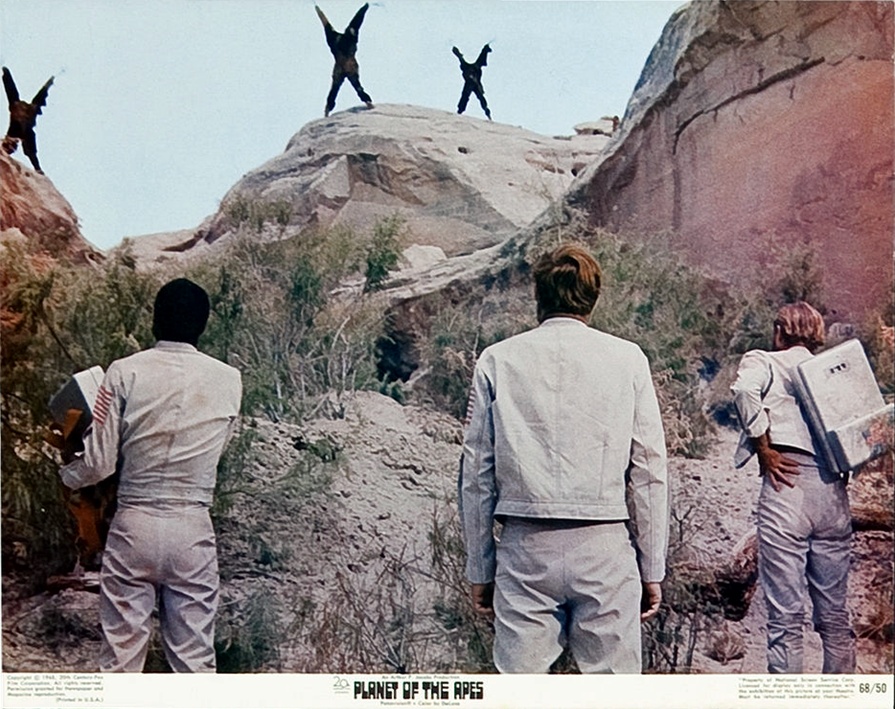
If you are entering Orc territory, how do they mark it? Is there some sort of perimeter fence, marked with "scarecrows" like in Planet of the Apes?


Except for unusual circumstances, let the players see their goal "from a distance", and give them plenty of opportunity to turn back.

3) Opposing Forces

A conflict can be much more dynamic if rather than just the players and their prey, there is a third player in the mix. This third player can help or hinder the party, but the main thing is that they are not allied with the monsters which the party is hunting. Maybe there is something they want, that the players can do for them in exchange for some assistance. This third party can be a witch, an orphan, a giant, a mermaid, or any entity that has its own goals and motives. 

"And then that mean old ogre stole my comb. You wouldn't mind getting it back for me, would you?"

4) Try to make it scary.

I mean, here the players are, crawling in dark holes, feeble torch in hand, trying to hunt down something before it hunts them. There's always room for a little Michael Myers type of action:

Put the SURPRISE! back in surprise


5) Make it creepy

There is always room to make a scene creepy. A little music box. Mist. Howling. And kids.

I'd start running about now

6) Use humor

When all else fails, use humor. I tell this to my haunted house actors. You aren't going to scare everybody. And really, you job isn't to scare them. It is to entertain them. So if Plan A doesn't work, use Plan B. Or C. Or whatever you have to do. Just keep it fun.

"Sorry for scaring you with the scarecrow mask and all that. If you can out-drink Og here, you can have the map!"


Haunted Houses Part 3: Incident at Froggy Bottom

For the next five years following Grimmwood I worked desiging in theme parks for Halloween. The work was steady, paid well, was low risk comparing to producing your own event, and allowed me huge creative freedom. Things wound down in 2008, and in 2009 I found myself once again with an empty barn to fill.


At this point, I was not interested in super-imposing something onto an existing structure. That is, I put a gothic manor house inside the last barn. This time, I wanted whatever was in there to make sense in the context of it being a barn.

Why was this farm "haunted"? Why were people going into the barn? What was in there?

I settled on an idea... that the farm had been contaminated by a meteor. Some sort of virus. Mutants, zombies, mayhem. At the time, there was an "incident" at a local theme park. People believed that they saw some sort of "ufo" in broad daylight. It was humorous, and the perfect thing to build upon.


So I just had to create my own video:


So... now we have a "What?" We also have a "Where?" (On the farm). We also have a "When?" The video above was posted August 4th (Nearly two months before our event would open).  Next up was the "Who?"

I decided that there would be two distinct groups. One to expose what was happening to the public, and another to try to cover it up. Thus were born PHRAWG (Paranormal Heuristic Research Awareness Group), and Darkwater Industries. For PHRAWG, I created a blog. For Darkwater, I created this poster:


The essence of the event was that Darkwater had taken over the entire farm, and was doing experiments, but due to the Freedom of Information Act and interference from the PHRAWG activists, the site was open to the public. Darkwater agents in hazmat suits lambasted you for being foolish enough enter the barn, and warned you that if you were contaminated they would have to kill you. Once in the barn, the "experiements" break free, and all hell ensues.

Something lurking overhead

Corpse "Re-vivification"

Human-Arachnid Hybrid

Human-Animal Hybrid

All in all, the event was very well received. Many people commented it was the best haunt they had ever been to. It was humorous, creepy, and scary as shit.

Next up: Design Considerations